One Worker, Five Brands, One Inbox
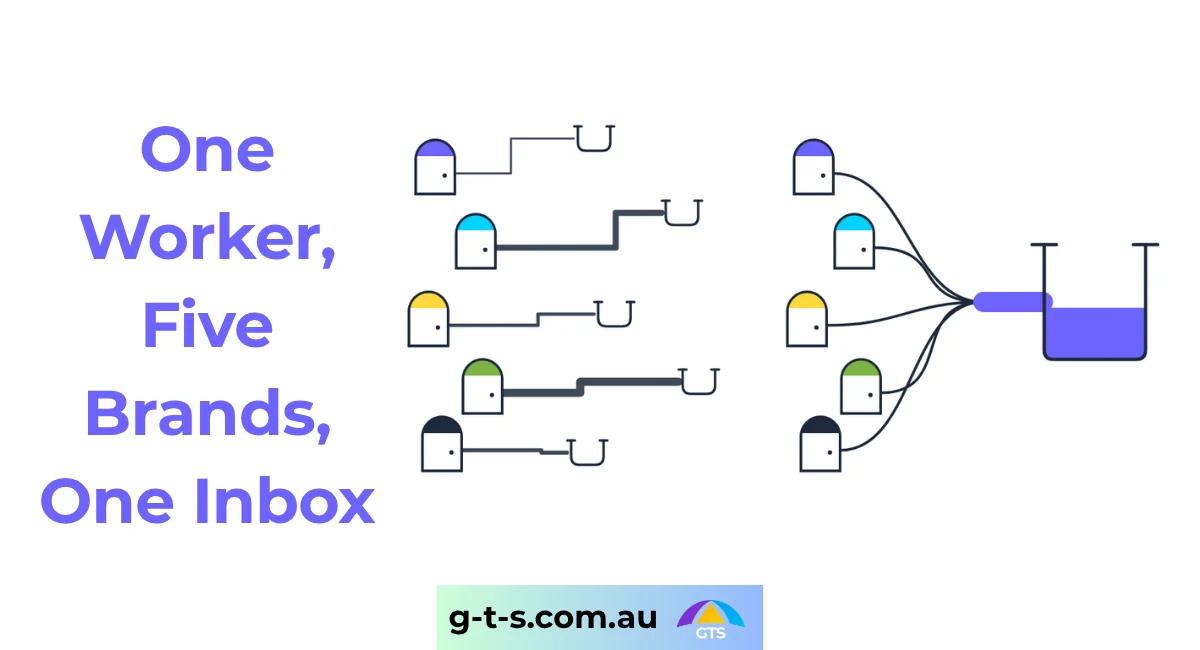
Five websites meant five contact forms, five spam problems and five places a lead could go missing. Consolidating them onto one service took a day. The decision to do it took two years, and the arithmetic that finally settled it applies to most multi-site businesses.
If your business runs more than one website, answer this without looking: when someone fills in a form on one of them, what happens next?
Most multi-site businesses can answer for their main site and go vague after that. Not because nobody built the others — someone did, competently, at the time — but because each was built separately, in a different month, with whatever was reasonable then. The result is not a system. It is five systems that happen to share a logo.
We had exactly that across five of our sites, and on 25 September we replaced it with one.
The arithmetic that finally settled it
The argument against consolidation is always the same and it is a good one: the forms work. Each site has a form, the form sends a message, the message arrives. Rebuilding something that works is how technology budgets get wasted.
What changed the calculation was not a failure. It was counting the cost of the fragmentation on the days it actually bit.
A lead does not arrive. Someone rings and says they filled in the form last Tuesday and never heard back. The work required to answer that is: establish which site they were on, find out what that site’s form does, check whether it had spam protection and whether the protection rejected them, check whether it wrote to the customer database or only sent an email, and check whether the email went anywhere useful.
Half an hour, roughly, and most of it is re-learning something you already knew once. Five sites means five versions of that half hour, and the version you need is always the one you have not done recently.
That is not a large cost per incident. It is a large cost per incident multiplied by the fact that it always happens on the enquiry that mattered, because the ones that arrive fine never get investigated. The selection bias is the whole point: the fragmentation is invisible on good days and maximally expensive on bad ones.
What one path buys
Every form on all five brands now runs through the same sequence.
Spam is stopped the same way everywhere. A challenge and a hidden field, on every form, rather than on whichever sites happened to get it.
The email address is checked before anything else. Typos, disposable addresses and mailboxes that do not exist are caught at the moment of submission rather than discovered later as a bounce. This one change removes a category of “the lead went missing” that was really “the lead gave us an address with a typo in it and nothing noticed”.
The customer record is created or updated by email address. Previously each site posted into a specific numbered form in our customer database, and if the site’s form and that numbered form had drifted apart, the extra fields were discarded without complaint. Every status code said success. Matching on the email address instead removes the coordination entirely, and a repeat enquirer updates their existing record rather than becoming a second one.
The person confirms their own address. A branded email goes out; clicking the link is what marks them confirmed. Nothing automated sends to anyone who has not clicked. This protects the thing most businesses do not realise they are spending: the reputation of your sending domain, which is shared by your quotes and invoices, not just your marketing.
Every brand still looks like itself. Five templates, so a Cosmos Web Tech enquiry gets a Cosmos Web Tech email. Consolidating the plumbing does not mean consolidating the brand, and a confirmation email from a parent company the person has never heard of is a spam complaint waiting to happen.
★ Insight ─────────────────────────────────────
The integration that was quietly losing data returned HTTP 200 every time. It accepted the submission, discarded the fields it did not recognise, and reported success. Monitoring is built to catch failures, so it reported perfect health for as long as this ran. If you have any integration that accepts arbitrary fields and always succeeds, the only real check is reading back what you wrote — and almost nobody does.
─────────────────────────────────────────────────
What it cost, honestly
One day of build for the shared service, plus roughly half a day per site to switch the forms over and test them.
And it is not finished. The confirmation email on one site landed in Spam during testing, because the DNS records authenticating our sending domain are not fully in place. That is a real defect with a real consequence — someone contacts us, never sees the confirmation, and never hears back — and it is the next task rather than a footnote. A full browser test of every form on every site is also still outstanding.
We are saying so because a consolidation write-up that ends at “and then it all worked” is not useful to anyone deciding whether to do the same thing. The honest status is: the service is built and verified end to end, most of the forms are switched over, and two things need finishing.
Whether it is worth it for you
The threshold is roughly three sites, but the number is not really the test.
The test is the question at the top of this post. If you cannot say what happens after a form submission on each of your sites — and specifically, where you would look first when one goes missing — then the fragmentation is already costing you. It is just costing you in a form that never appears on an invoice: half an hour here, a lost enquiry there, and a slowly growing reluctance to touch any of it.
Three questions worth asking your own team this week:
- How many places can a lead land? Count inboxes, databases and spreadsheets. Most businesses are surprised.
- Which forms have spam protection? Not “do we have spam protection” — which forms.
- When did anyone last submit your own forms and check what arrived? Every field, on every site. It takes twenty minutes and it finds things.
That third one is the whole audit, really. A form is the only part of your website a customer uses to become a customer, and it is the part least likely to have been opened since it was built.
Ganda Tech Services runs web, cloud, mobile and content operations for Australian businesses through Cosmos Web Tech, Cloud Geeks, Awesome Apps and AI Consulting. The engineering detail behind this consolidation is on Cloud Geeks Insights.