Cloud, Web, and App: Choosing the Right Digital Stack for Your Business
A strategic guide for Sydney SMBs on choosing the right combination of cloud services, web design, and mobile apps to build a digital stack that drives growth.
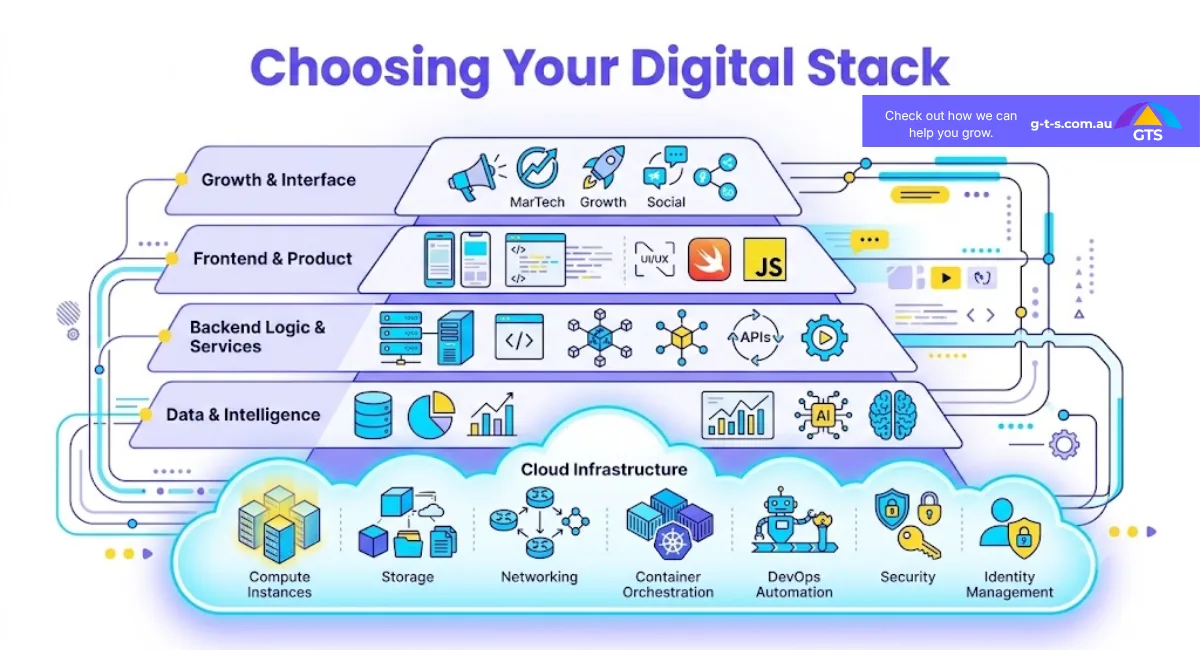
For Australian small and medium businesses, the question is no longer whether to invest in digital — it’s where to invest first. A café in Parramatta, a medical practice in the Hills District, and a logistics firm in Western Sydney each face the same strategic dilemma: which combination of cloud services, web presence, and mobile applications will actually move the needle for their business?
Get the mix right and your digital stack becomes a quiet competitive advantage. Get it wrong and you end up with disconnected tools, duplicated costs, and a team that resents technology rather than relies on it. This guide walks through how to think about your stack as an integrated system rather than three separate purchases.
What Makes Up a Modern Digital Stack
A digital stack is the layered set of technologies that supports how your business operates, communicates, and delivers value. For most Sydney SMBs, three layers do the heavy lifting:
Cloud Infrastructure
The compute, storage, and security services that run behind the scenes — typically Microsoft 365, Azure, AWS, or Google Workspace — alongside backup, identity, and cybersecurity tooling.
Web Presence
Your public website, landing pages, e-commerce store, and the content management system that drives them. This is usually the first surface a prospective customer touches.
Mobile Applications
Native or cross-platform apps that serve customers, field staff, or internal teams where a browser-based experience won’t cut it.
These layers are not interchangeable. They serve different business jobs, and the worst outcomes happen when leaders treat them as a shopping list rather than a system.
Cloud Services: The Foundation Most Businesses Underestimate
Cloud services are the least visible part of your stack and, for that reason, the most often under-invested in. Yet the cloud layer determines how reliably your business runs day to day.
For a typical Western Sydney SMB with 10 to 50 staff, a sensible cloud foundation includes:
- Identity and access management so the right people can reach the right systems without friction
- Email, document collaboration, and file storage standardised on a single platform rather than scattered across personal accounts
- Backup and disaster recovery that is tested, not just configured
- Endpoint security and patching to keep laptops, mobiles, and servers protected against the threats that target small businesses most often
- Monitoring and managed support so issues are caught and resolved before they become outages
The strategic question isn’t “which cloud provider?” — it’s “what level of operational resilience does our business need, and what are we willing to pay for it?” A medical practice in Castle Hill handling sensitive patient data has a very different risk profile to a digital agency in Surry Hills. The cloud spend should reflect that.
If you’re spending less than two to three per cent of revenue on cloud and IT, you’re almost certainly under-protected. If you’re spending more than six per cent without a clear reason, you’re almost certainly paying for tools you don’t use.
Web Design: Your Digital Storefront, Not a Brochure
Your website is no longer a digital brochure. For most Sydney SMBs, it’s the highest-leverage marketing asset you own — and increasingly, the surface where AI search engines, voice assistants, and review aggregators decide whether to recommend you.
A modern SMB website does four jobs at once:
- Demonstrates credibility within seconds of landing
- Answers the questions prospective customers actually ask
- Captures intent through clear calls to action and conversion paths
- Feeds the broader ecosystem — Google Business Profile, local directories, AI overviews, and review platforms
This is why we steer clients away from template-driven, generic builds and toward purpose-designed sites that reflect how their customers actually buy. A plumber in Penrith and a financial adviser in North Sydney don’t need the same site, even if both are “service businesses with five people.”
Crucially, web design now overlaps heavily with search optimisation. A beautifully designed site that doesn’t rank, doesn’t load fast, doesn’t surface in AI answers, and doesn’t convert is a wasted investment. Treat web design and SEO as one discipline, not two.
For most SMBs, the right starting point is a well-structured, content-rich website on a maintainable platform — not a custom-built application. Reach for complexity only when your business model demands it.
Mobile Apps: When You Actually Need One
Mobile apps are where most SMBs over-invest. The instinct to “have an app” is rarely matched by a clear business case for one. Before committing to an app build, work through three questions:
- Will users open this more than once a week? If not, a responsive website usually wins.
- Does the experience need device capabilities — camera, GPS, offline mode, push notifications, biometric login — that a browser can’t deliver well?
- Is there a recurring relationship between your business and the user that justifies the install friction?
When the answer to all three is yes, mobile apps unlock genuine value. NDIS providers tracking shifts in the field, allied health practices managing recurring bookings, fitness studios driving daily engagement, and logistics operators capturing proof of delivery all have legitimate cases for native or cross-platform apps.
When the answer is no, the same budget invested in a faster, better-converting website usually returns more. The honest conversation upfront saves six-figure regret eighteen months later.
If an app is the right answer, the secondary decision is technology: native iOS and Android, React Native, or Flutter. The right choice depends on team capability, performance requirements, and how quickly you need to move. Cross-platform frameworks have closed most of the gap with native for typical business apps and usually deliver lower total cost of ownership.
How These Three Layers Work Together
The biggest mistake we see in Sydney SMBs is treating cloud, web, and mobile as three separate procurement decisions handled by three separate vendors. The result is predictable: customer data sits in five places, marketing can’t see what sales is doing, the app and the website tell different stories, and IT support becomes a finger-pointing exercise.
A coherent digital stack is integrated by design:
- Customer data flows from website forms and app activity into your CRM, with cloud-based identity tying it together
- Content created once appears across web, app, and email channels rather than being rebuilt three times
- Security and access controls are applied consistently across every surface
- Analytics and reporting give leadership a single picture of digital performance, not three disconnected dashboards
This integration is where strategic value compounds. It’s also where most SMBs need outside help, because no single in-house hire usually covers cloud, web, and mobile at the depth required.
Choosing Your Stack: A Decision Framework
When advising Sydney SMBs on stack decisions, we work through four questions in order:
- Where does revenue actually come from today? Invest first in the layer that supports current revenue, not the layer that feels most exciting.
- Where is the biggest operational risk? A weak cloud foundation almost always poses a larger risk than a dated website.
- Where is the biggest growth opportunity? This is usually web and content for service businesses, and apps for businesses with recurring customer relationships.
- What can the team realistically operate? A best-in-class stack that no one in the business understands is a liability, not an asset.
Sequencing matters as much as selection. For most SMBs, the right order is: stabilise the cloud foundation, then upgrade the web presence, then evaluate whether an app is genuinely warranted.
The Bottom Line for Sydney SMBs
Choosing the right digital stack is less about picking the best individual tools and more about designing a coherent system that fits your business model, your customers, and your team. Cloud gives you operational resilience. Web gives you reach and credibility. Mobile gives you engagement where it’s earned.
Get the order right, integrate the layers, and treat the stack as a long-term strategic asset rather than a series of one-off projects. That’s the difference between technology that drains your business and technology that compounds its value.
If you’re weighing where to invest next across cloud, web, and mobile, start with an honest audit of where your current stack helps you win business and where it quietly costs you customers. The answer almost always points to the right next move.
A fourth division, AI Consulting, covers where automation genuinely fits in a business and where it does not.